Russian Jet-Powered Drone Strikes Ukraine’s National Academy of Sciences in Kyiv
A strike on Kyiv’s National Academy of Sciences came amid wider attacks on Ukrainian cities, highlighting the growing challenge posed by faster jet-powered drones.
DWN · 3 min read Published 28 September 2026 Original source date: 28 September 2026
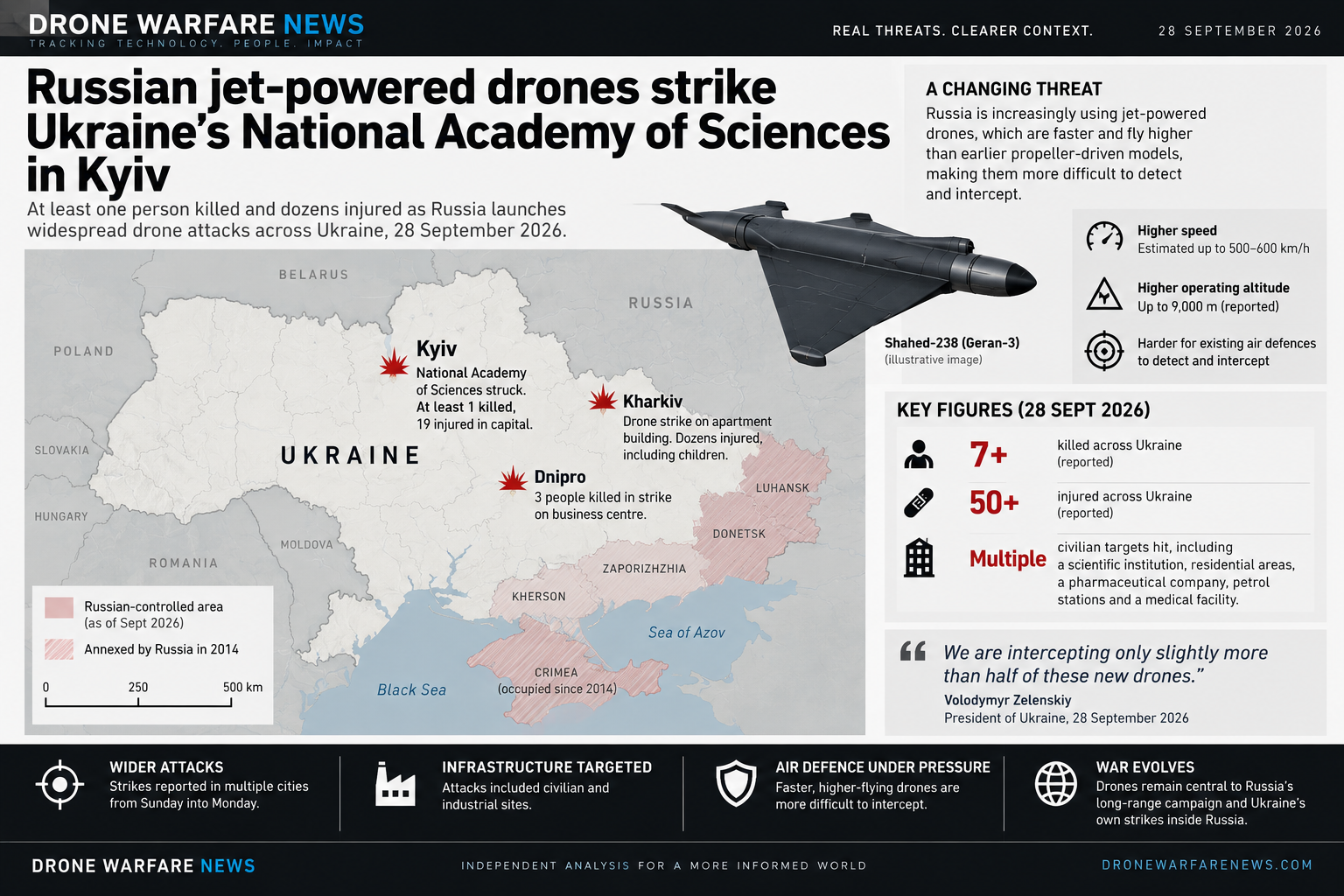
Original editorial illustration, not a photograph. The map is schematic: its shading is not a verified front line or territorial-control map. Aircraft model and speed labels are illustrative estimates, not confirmed specifications of the drone used in this attack. The displayed quotation is a paraphrase of remarks made on 26 September, as reported by Reuters, rather than a verbatim statement made on 28 September. Graphic: Drone Warfare News · Original graphic.
Kyiv, Ukraine
A Russian jet-powered drone struck the National Academy of Sciences of Ukraine in central Kyiv on Monday, killing at least one person and setting part of the historic scientific institution ablaze as a wider series of drone attacks hit Ukrainian cities.
Reuters reported that Kyiv Mayor Vitali Klitschko said 19 people were injured across the capital during the attacks, with six receiving hospital treatment. Ukrainian officials also reported strikes on a pharmaceutical company, petrol stations and a medical facility.
The Associated Press reported that the wider Russian bombardment from Sunday into Monday killed at least seven people across Ukraine and wounded more than 50. Three people were reported killed when a drone struck an office centre in Dnipro, while a strike on an apartment building in Kharkiv injured dozens, including children.
The attack is notable not simply because of where it occurred, but because of the type of weapon being increasingly deployed.
Russia has expanded its use of faster, higher-flying jet-powered drones against Ukrainian cities. Reuters reported that Ukrainian President Volodymyr Zelenskiy said Ukraine was intercepting only slightly more than half of these newer drones — substantially below interception levels previously achieved against slower propeller-powered variants.
Their greater speed and operating altitude create a more difficult target for some of Ukraine’s existing low-cost air-defence systems.
The strike on the Academy therefore highlights a developing problem in the drone war: as relatively inexpensive unmanned weapons become faster and more capable, defenders must continually adapt their interception technology and tactics.
Monday’s attacks also demonstrate how drone warfare increasingly reaches far beyond front-line positions.
Reuters reported strikes against civilian facilities, businesses and communications infrastructure in several regions. In Dnipro, officials said a drone struck a business centre during working hours, killing three people.
Russia says its attacks are directed at military-related targets. Ukraine and international reporting have documented repeated impacts on residential areas and civilian infrastructure. Both Russia and Ukraine deny deliberately targeting civilians.
Ukraine, meanwhile, continues its own long-range drone campaign inside Russia. Ukrainian officials said strikes overnight targeted Russian oil facilities and defence-industrial sites, while Russia’s Defence Ministry claimed its air defences intercepted 254 Ukrainian drones. The interception total is a Russian claim reported by the Associated Press, not an independently verified figure.
The September 28 attacks illustrate how rapidly the aerial contest is evolving.
Drones that were once principally associated with battlefield reconnaissance and tactical strikes are now central to sustained long-range campaigns against infrastructure, industry and urban areas.
The emergence of faster jet-powered attack drones further complicates the economics of air defence: Ukraine must find ways to destroy large numbers of incoming unmanned aircraft without routinely relying on substantially more expensive interceptor missiles.
That technological contest — between increasingly capable attack drones and increasingly specialised counter-drone systems — is becoming one of the defining features of the war.
DWN interpretation is identified in the text. This is not original field reporting or independent technical validation. Historical background retains its original dates; a later expansion date does not turn an old announcement into new news.
Fresh reporting from Project Convergence details overheating, battery and signal problems affecting selected systems. The July exercise was experimental, and no comprehensive Army scorecard has been released.
Published 11 October 2026Source date: 20–29 July 2026
Bulgarian authorities say sea and aerial drones struck two commercial vessels on 6 October. One ship sank and another crew was rescued, while responsibility for the attack remains under investigation.
Published 7 October 2026Source date: 6 October 2026
A September exercise at Yuma has become a continuing test programme as the military reports hundreds of recent drone detections along the US–Mexico border. The figures and system results remain only partly public.
Published 6 October 2026Source date: 5 October 2026
Russian Jet-Powered Drone Strikes Ukraine’s National Academy of Sciences in Kyiv | Drone Warfare News